The 5 Best Water Filters for Camping and Survival (2026)
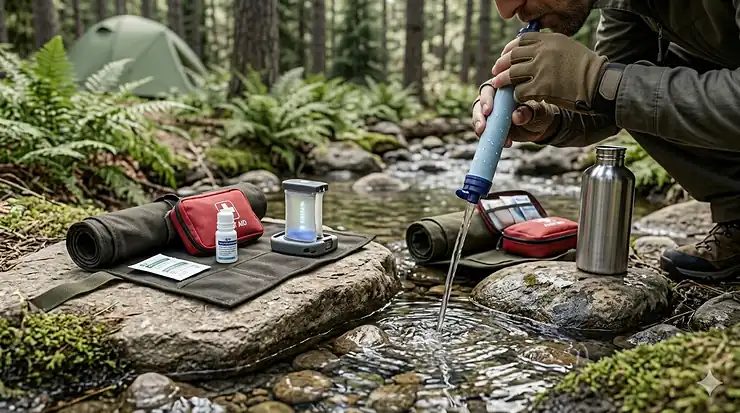
Bad water ruins trips faster than bad weather. Giardia doesn't care that you drove six hours to get to the trailhead. The fix is cheap, light, and simple: a backcountry filter that turns any creek, lake, or sketchy gas-station tap into safe drinking water in minutes.
This guide is built from manufacturer spec sheets and years of long-term owner reports from thru-hikers, hunters, and preppers — not from hands-on testing, and not from sponsors. Every filter below is a current model, actively sold in 2026 lineups, ranked by what actually matters when you're miles from a faucet.
What Actually Matters: The Specs Worth Reading
Filter Type: Squeeze vs Pump vs Gravity vs Bottle
There are four architectures, and the right one depends on how you move. Squeeze filters (Sawyer Squeeze, Katadyn BeFree, LifeStraw Peak) screw onto a soft flask — you fill the flask, squeeze, and drink. They're the lightest and fastest for solo hikers. Pump filters (MSR Guardian) push water through a handle-operated pump into your bottle — heavier, but they handle turbid, silty water that would clog a squeeze filter. Gravity filters hang a dirty reservoir above a clean one and let physics do the work — best for groups and basecamps. Bottle purifiers (Grayl GeoPress) press the water through a cartridge in eight seconds — the simplest thing here, but you're limited to one bottle at a time.
Flow Rate
Flow rate is how fast clean water comes out, usually measured in liters per minute. This is the spec that separates a good filter from an annoying one. Anything under 1 L/min will have you standing at the creek swearing; 2–3 L/min feels effortless. Note that manufacturer numbers are best-case — flow drops as the filter clogs.
Weight
Water treatment is one of the few gear categories where you can drop real pack weight for under $50. A 3-ounce squeeze filter replaces carrying liters of water between sources. If you're an ultralight hiker, this spec decides your pick. If you're car camping, ignore it entirely.
Cartridge Life
Hollow-fiber membrane filters (Sawyer, LifeStraw, BeFree) are rated for thousands to tens of thousands of liters and can be backflushed in the field to restore flow. Press-cartridges (Grayl) last around 250 liters and then get replaced — no backflushing. Divide the filter's price by its cartridge life and you'll see why membrane filters are the better long-term buy for heavy users.
Virus vs Bacteria Protection
Most backcountry filters remove bacteria (99.99999%) and protozoa like Giardia and Cryptosporidium — that's enough for North American wilderness. Viruses (norovirus, hepatitis A, rotavirus) are much smaller and pass straight through hollow-fiber membranes. For US/European backcountry, you don't need virus protection. For international travel, developing regions, or disaster scenarios, you do — that's the Grayl GeoPress and MSR Guardian's whole reason to exist.
Our Picks
Sawyer Squeeze — Best Overall
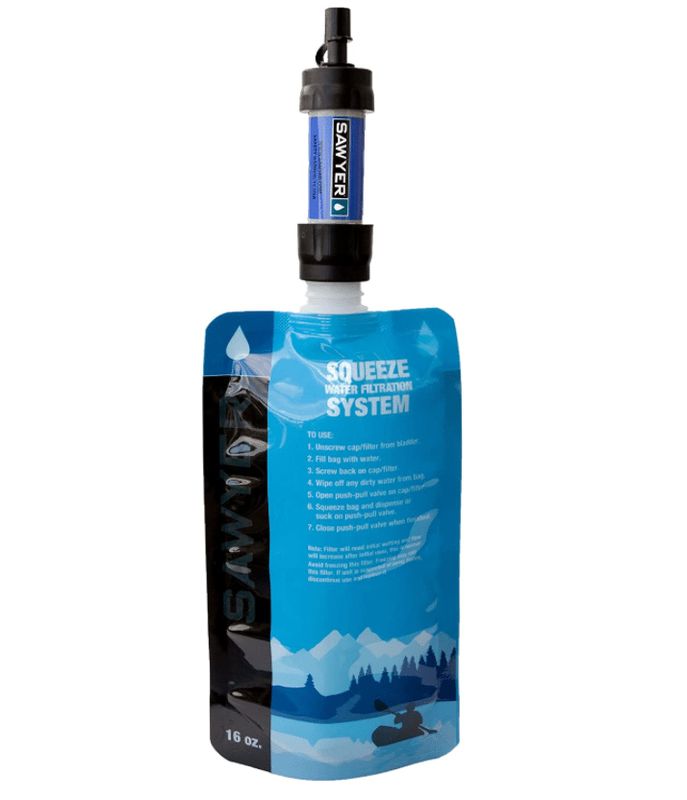
The Sawyer Squeeze is the most-carried filter on long trails for a reason: the spec sheet claims a 0.1-micron hollow-fiber membrane that removes 99.99999% of bacteria and 99.9999% of protozoa, rated for up to 100,000 gallons with proper backflushing. Owners consistently report that it just keeps working — thru-hikers run a single Squeeze for an entire 2,600-mile trail and backflush it at town stops.
At around 3 ounces for the filter (plus the pouch), it's ultralight without being flimsy, and the standard 28mm threading screws onto most disposable water bottles, which means the "dirty" container is replaceable at any gas station. The flow rate starts strong at around 1.7 L/min and owners say regular backflushing keeps it there. It also carries a lifetime manufacturer warranty, which makes the already-low price essentially a one-time purchase.
Key specs: 0.1-micron hollow fiber, ~3 oz filter, ~1.7 L/min, up to 100,000-gallon rating, 28mm standard thread, backflushable, bacteria + protozoa + microplastics.
Pros: - Near-infinite lifespan with backflushing — best long-term value on this list - Ultralight and packs down to almost nothing - Threads onto common disposable bottles for a replaceable dirty reservoir - Lifetime warranty from the manufacturer
Cons: - The included pouches are the weak point — they burst before the filter does; owners recommend upgrading to a tougher soft flask - No virus protection — fine for North American backcountry, not for overseas travel - Squeezing is a mild chore on high-volume days
Best for: Backpackers, thru-hikers, and anyone who wants the lightest proven system with the lowest lifetime cost.
Check current price: Sawyer Squeeze Water Filter System
Katadyn BeFree 1.0L — Fastest Flow, Easiest to Use
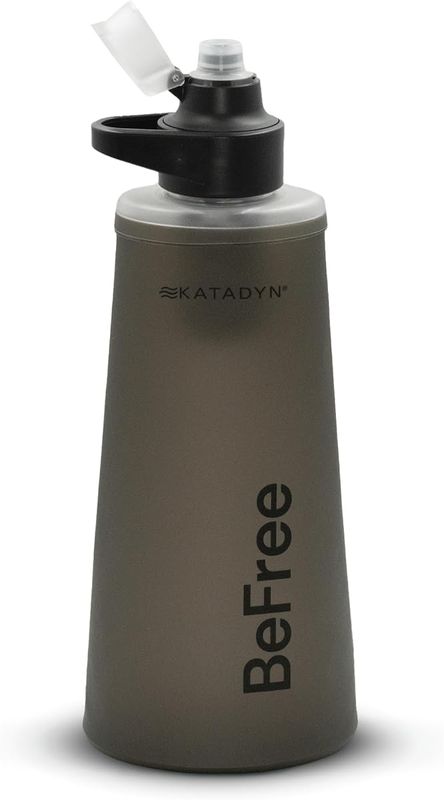
The BeFree is the scoop-and-go champion. The spec sheet lists a 0.1-micron hollow-fiber filter integrated into a collapsible 1-liter flask — you dunk the flask in the creek, screw on the cap, and drink straight through the filter. No squeezing, no pumping, no separate dirty container. Owners consistently report that when the filter is clean, nothing on the market flows faster.
The trade-offs are real, though. The soft flask is thin and doesn't always survive hard use, and the filter can't be backflushed the way a Sawyer can — Katadyn recommends swishing the cartridge in clean water, which doesn't fully restore flow. Service life is rated at 1,000 liters, after which you replace the cartridge. For three-season hikers in clear water who value speed and simplicity above all else, those trade-offs are worth it.
Key specs: 0.1-micron hollow fiber, ~2 oz (filter + flask), ~2 L/min when clean, 1,000 L cartridge life, bacteria + protozoa + microplastics.
Pros: - Fastest flow rate of any squeeze-style system when clean - Simplest workflow in existence: fill, screw, drink - Ultralight — under 2 ounces all-in - Collapses flat when empty
Cons: - Thin flask is the durability weak link - Can't be backflushed; flow degrades faster than a Sawyer - 1,000 L cartridge life means replacement cartridges on long routes
Best for: Trail runners, fast-packers, and day hikers who want water with zero fuss.
Check current price: Katadyn BeFree 1.0L
Grayl GeoPress — Best for International Travel and Emergencies
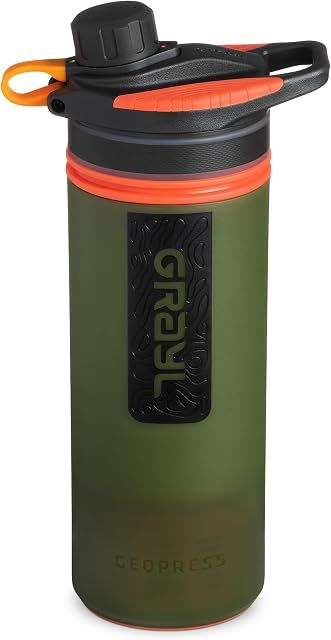
The GeoPress is a purifier, not just a filter — and that distinction matters. The press-cartridge removes bacteria, protozoa, and viruses, plus heavy metals, chemicals, and microplastics. The operation is dead simple: fill the outer cup, press the inner cartridge down like a French press, and in about eight seconds you have 24 ounces of safe water. No squeezing, no hoses, no waiting.
Owners and expert reviewers consistently rank it as the go-to for international travel in regions with questionable tap water, and it's a favorite in emergency kits and bug-out bags for the same reason: it handles the worst-case water. The price is the cartridge life — around 250 liters per cartridge, then you buy a replacement. For backcountry use where viruses aren't a concern, that's expensive overkill; for a go-bag or a trip to rural Asia, it's cheap insurance.
Key specs: Electroadsorption + activated carbon + silver, 24 oz capacity, ~8-second press, virus + bacteria + protozoa + chemicals + heavy metals, 15.9 oz, ~250 L cartridge life.
Pros: - True virus protection — the only bottle here that purifies, not just filters - Fastest full process of anything on this list (eight seconds) - Also strips chemicals, heavy metals, and bad taste - Bombproof construction; it doubles as a regular water bottle
Cons: - 15.9 ounces — by far the heaviest pick here - 250 L cartridge life means ongoing replacement costs - Overkill (and overpriced) for clean North American backcountry water
Best for: International travelers, disaster preppers, and emergency kits where the water quality is unknown.
Check current price: Grayl GeoPress 24 oz Water Purifier Bottle
LifeStraw Peak Series Solo — Best Ultralight and Budget
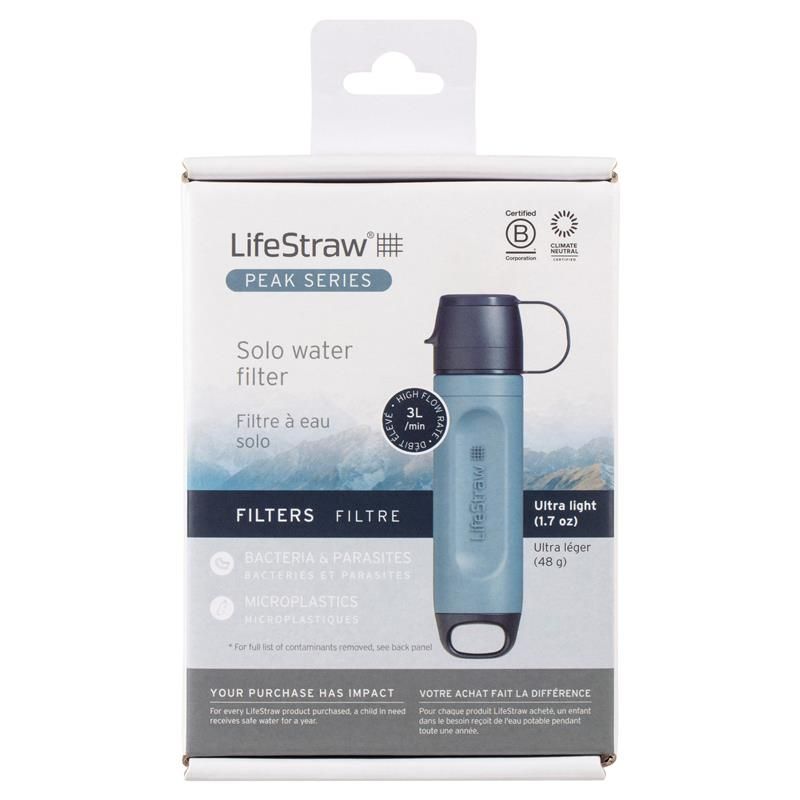
The LifeStraw Peak Series Solo is the lightest serious filter on this list — 1.7 ounces — and the cheapest at around $30. The spec sheet lists a 0.2-micron membrane filter that removes 99.999999% of bacteria and 99.999% of parasites and microplastics, rated for 2,000 liters, and it's backflushable to maintain flow.
It threads onto standard 28mm bottles and the included squeeze pouch, and owners consistently report that it flows faster than the classic LifeStraw straw design ever did. Expert roundups in 2026 keep flagging it as the pick for ultralight hikers who count every gram and for budget buyers who want a real filter, not a toy. It won't outlast a Sawyer over a thru-hike season, but at this weight and price, it doesn't have to.
Key specs: 0.2-micron membrane, 1.7 oz, ~3 L/min, 2,000 L rating, backflushable, bacteria + parasites + microplastics, 28mm thread.
Pros: - Lightest filter here at 1.7 ounces - Around $30 — the cheapest legitimate filter on this list - Fast flow and backflushable - Tiny enough to live permanently in a daypack as a backup
Cons: - 2,000 L lifespan is shorter than the Sawyer's — it's a consumable, not an heirloom - No virus protection - The squeeze pouch is small; owners pair it with a bigger soft flask
Best for: Ultralight hikers, budget buyers, and anyone who wants a filter so light and cheap there's no excuse not to carry one.
Check current price: LifeStraw Peak Series Solo Water Filter
MSR Guardian — Best for the Worst Water on Earth
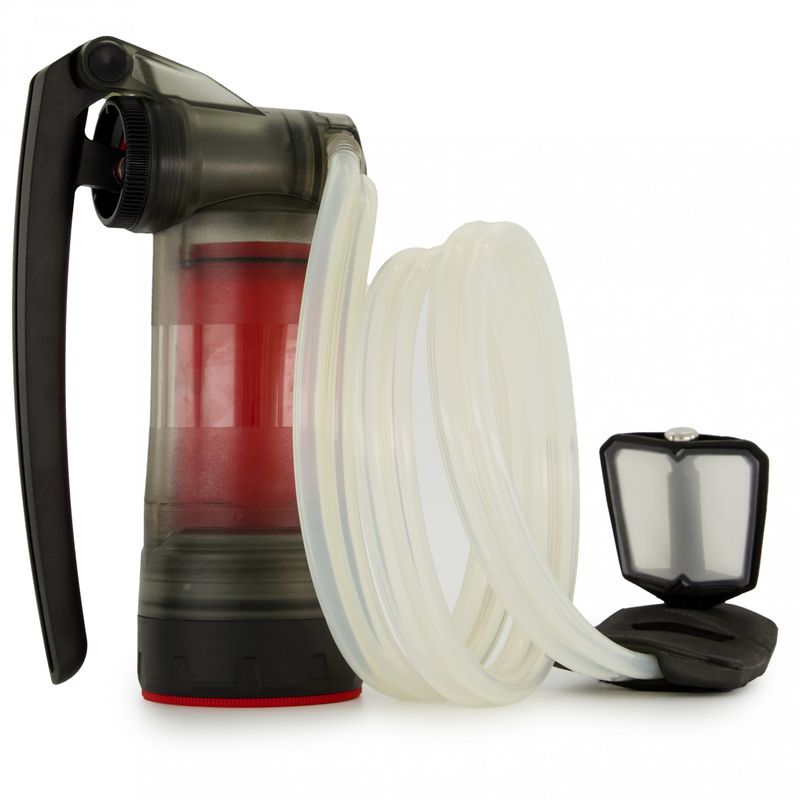
The MSR Guardian is the expedition tool. The spec sheet lists a medical-grade hollow-fiber purifier that removes viruses, bacteria, protozoa, and particulate, and — critically — it's self-cleaning: every pump stroke backflushes the filter, so it keeps flowing in turbid, silty, glacial-melt water that would clog every other filter here in an hour.
Owners consistently report that it's the filter you bring when the water looks like chocolate milk. The downsides are the weight (over a pound) and the price (around $400). This is not a backpacking filter; it's an expedition, overland, and humanitarian-relief filter. But if your scenario involves remote regions, flood zones, or genuinely foul water sources, nothing else here is in its league.
Key specs: Medical-grade hollow-fiber purifier, virus + bacteria + protozoa + particulate, 2.5 L/min, self-cleaning on every stroke, 10,000+ L rating, ~1 lb 1 oz.
Pros: - Handles the most turbid water of any portable filter - Self-cleaning — no field maintenance, ever - Virus protection for remote and international use - 10,000+ liter lifespan; built like expedition equipment
Cons: - Around $400 — ten times the price of a Sawyer - Over a pound — too heavy for normal backpacking - Overkill for clear North American trail water
Best for: Expedition leaders, overlanders, and preppers who need the filter that works when everything else clogs.
Check current price: MSR Guardian Water Purifier
Comparison Table
| Model | Type | Weight | Flow Rate | Cartridge Life | Removes Viruses? | Approx. Price |
|---|---|---|---|---|---|---|
| Sawyer Squeeze | Squeeze | ~3 oz | ~1.7 L/min | Up to 100,000 gal | No | ~$40–$60 |
| Katadyn BeFree 1.0L | Squeeze bottle | ~2 oz | ~2 L/min | 1,000 L | No | ~$60 |
| Grayl GeoPress | Press bottle | 15.9 oz | 24 oz / 8 sec | 250 L | Yes | ~$100 |
| LifeStraw Peak Solo | Squeeze | 1.7 oz | ~3 L/min | 2,000 L | No | ~$30 |
| MSR Guardian | Pump purifier | ~1 lb 1 oz | 2.5 L/min | 10,000+ L | Yes | ~$400 |
How to Choose: A 60-Second Decision Guide
- You hike or backpack in North America: Get the Sawyer Squeeze. Lightest proven system, lowest lifetime cost, lifetime warranty.
- You want the easiest possible water: Get the Katadyn BeFree. Fill, screw, drink — nothing to squeeze or pump.
- You're traveling internationally or building a go-bag: Get the Grayl GeoPress. Virus protection in an eight-second press.
- You count every gram or every dollar: Get the LifeStraw Peak Series Solo. 1.7 ounces, around $30, genuinely good.
- You're heading somewhere with truly awful water: Get the MSR Guardian. It self-cleans and purifies the worst sources on earth.
- You're filtering for a group at basecamp: Any of the squeeze filters paired with a gravity setup works — the Sawyer threads onto standard reservoirs for hands-free gravity filtering.
FAQ
Do I need a filter that removes viruses?
For backcountry water in North America and Europe, no — bacteria and protozoa (Giardia, Cryptosporidium) are the real threats, and every filter here handles those. Viruses matter for international travel in developing regions, flood zones, and disaster scenarios. If that sounds like your trip, get the Grayl GeoPress or MSR Guardian.
Can I use a squeeze filter as a gravity system?
Yes — and thru-hikers do it constantly. The Sawyer Squeeze's standard 28mm threading screws onto most hydration reservoirs and smartwater-style bottles, so you can hang a dirty reservoir above a clean one and let gravity push water through while you set up camp. It's the best free upgrade in water treatment.
How do I keep my filter from freezing?
Hollow-fiber membranes can crack if water inside them freezes, ruining the filter with no visible sign. In freezing conditions, sleep with your filter in your sleeping bag and never leave it in an outside pack pocket overnight. This is the number-one way people silently kill their filters.
How often should I backflush?
Backflush whenever you notice the flow slowing down — for a Sawyer or LifeStraw Peak, that's typically every few days of heavy use. Carry the backflush syringe (Sawyer includes one) and use clean water. Thirty seconds of backflushing restores most of the original flow.
Is it safe to drink straight from a mountain stream?
Statistically, most high mountain streams are fine — but "most" isn't a plan. Giardia and agricultural runoff don't announce themselves, and one bad source can end your trip with a week of misery. A 3-ounce filter removes the gamble entirely. Always filter.
What's the difference between a filter and a purifier?
A filter physically removes bacteria and protozoa through microscopic pores. A purifier (Grayl, MSR Guardian) also neutralizes or removes viruses, either through finer media, electroadsorption, or chemical action. Purifiers cost more and weigh more — buy one only if viruses are actually a risk on your trip.
Can I filter salt water with any of these?
No. None of these remove dissolved salt — that requires reverse osmosis or distillation. Filtering seawater through a backcountry filter will clog it and won't make it drinkable. If you need desalination, that's a different (and much more expensive) category of equipment.
Verdict
For backcountry use, the Check current price: Sawyer Squeeze Water Filter System remains the filter to beat: three ounces, backflushable to a near-infinite lifespan, and cheap enough that there's no excuse not to own one. If speed and simplicity matter more than longevity, the Check current price: Katadyn BeFree 1.0L is the easiest water you'll ever drink. And if your water might carry viruses — international travel, emergencies, the unknown — the Check current price: Grayl GeoPress 24 oz Water Purifier Bottle is the one to trust.
Whatever you buy, test it at home before the trip. Fill it, drink from it, backflush it. The creek at mile twelve is the wrong place to discover you never learned how your filter works.