The 5 Best Pellet Grills Under $1000 (2026 Buyer's Guide)
A grand is the line in the sand. Below it, you get serious cooking machines. Above it, you get diminishing returns and a lighter wallet.
This guide is built from spec sheets, manufacturer documentation, and thousands of long-term owner reviews — not sponsored placements. Every grill below is a current model, actively sold in 2026 lineups. A few notes on what's changed: Traeger discontinued the Pro 575 and Pro 780 in early 2025, so they've been replaced here by the current Traeger Westwood. The Traeger Ironwood 650, excellent as it is, now lists above $1,000, so it doesn't qualify for this list. What made the cut are five grills that owners consistently rate as the best value in the game.
What Actually Matters: The Specs Worth Reading
Marketing copy will try to sell you on everything. These are the six specs that actually decide whether you'll love your grill two years from now.
Cooking Area
Square inches are the headline number, but layout matters more than the total. A 650-square-inch grill with two usable tiers handles a brisket plus sides; a single-rack 800-square-inch grill wastes space on tall cooks. For a family of four, 550–700 square inches is the sweet spot. Regularly feeding a crowd? Aim for 800+.
Hopper Capacity
The hopper is your fuel tank, and it decides whether you sleep through an overnight brisket. Pellet grills burn roughly 1–2 pounds of pellets per hour depending on temperature, so a 20-pound hopper buys you 10+ hours at smoking temps. Anything under 18 pounds means refilling mid-cook on long smokes. Bigger is always better here.
Temperature Range and Controller Quality
A true PID controller holds your set temperature within a few degrees instead of swinging wildly — it's the single biggest difference between a frustrating grill and a set-and-forget one. Temperature range decides versatility: 160–450°F covers smoking and roasting, but if you want real searing, you need a grill that pushes past 500°F or offers a direct-flame option.
Build Quality and Materials
Pellet grills live outside. Powder-coated steel is standard; double-wall insulation is the upgrade that pays for itself in cold weather and lower pellet consumption. Stainless steel firepots and grates resist corrosion far longer than porcelain-coated steel, which chips and rusts if you get lazy with maintenance.
Pellet Consumption
The sticker price is only the down payment. A poorly insulated grill can burn through noticeably more pellets per cook than a well-sealed one — owner testing consistently shows cheaper, thinner grills costing more per year in fuel. Over a decade of weekend cooking, efficiency can erase a few hundred dollars of upfront savings.
WiFi and App Quality
WiFi lets you monitor and adjust a cook from the couch, and a good app adds recipes, timers, and probe alerts. Traeger's app is widely considered the most polished in the category; everyone else's ranges from solid to forgettable. Nice to have, not a dealbreaker — a grill that can't hold temperature is useless no matter how good its app is.
Our Picks: The Best Pellet Grills Under $1000
1. Traeger Westwood — Best Traeger Under $1000
Traeger killed off the legendary Pro Series in 2025 and replaced it with the Westwood: a simpler, cheaper entry point into the Traeger ecosystem at around $700. The spec sheet lists 653 square inches of dual-tier cooking space, an 18-pound hopper, and a 180–450°F temperature range with WiFIRE connectivity to the Traeger app.
Owners consistently report that the Westwood nails the fundamentals — steady temperatures, clean smoke flavor, and the most intuitive app in the category. The trade-offs are real, though: no Super Smoke mode, no Keep Warm mode, no pellet sensor, and a 450°F ceiling means searing is off the menu. It's a deliberate simplification, not a flagship.
Key specs: 653 sq in cooking area · 18-lb hopper · 180–450°F · WiFIRE WiFi · P.A.L. accessory rail · 3-year warranty
Pros: - Cheapest way into the Traeger ecosystem, around $700 - The best companion app in the pellet grill world - P.A.L. rail and ModiFIRE accessories add customization - Built-in side shelf and bottom storage shelf included
Cons: - 450°F max temperature — no real searing - No Super Smoke or Keep Warm modes - No pellet level sensor - Single wired probe port
Best for: First-time pellet grill buyers who want the Traeger name, the best app, and a proven platform without crossing $750.
Check current price: Traeger Westwood Pellet Grill
2. Camp Chef Woodwind WiFi 24 — Best Features for the Money
The Woodwind WiFi 24 is the spec-sheet bully of this list. For around $900 you get 800 square inches of cooking space, a 22-pound hopper, a 160–500°F range, and the Slide and Grill system that opens direct flame access for searing up to 650°F. The PID controller pairs with the Camp Chef Connect app and lets you dial smoke output on a 1–10 scale.
Owner feedback centers on two things: the ash cleanout system, which owners call the easiest in the business, and the four included meat probes — double what most competitors include. The full-color controller screen is a nice touch. Fit and finish gets occasional knocks compared to premium brands, and the app isn't as polished as Traeger's, but the feature-per-dollar ratio is unmatched.
Key specs: 800 sq in cooking area · 22-lb hopper · 160–500°F (650°F direct-flame sear) · WiFi PID controller · 4 meat probes · ash cleanout system
Pros: - Most cooking space and biggest hopper in this price tier - Slide and Grill direct-flame searing to 650°F - Patented ash cleanout makes maintenance nearly painless - Adjustable smoke settings (1–10) for flavor control - Four meat probes included
Cons: - App is functional but not best-in-class - Fit and finish a step below Weber and recteq - Sidekick accessories (griddle, sear box) cost extra
Best for: Cooks who want maximum versatility — low-and-slow smoking one day, direct-flame searing the next — without paying flagship money.
Check current price: Camp Chef Woodwind WiFi 24 Pellet Grill and Smoker
3. Weber Searwood 600 — Best for Searing
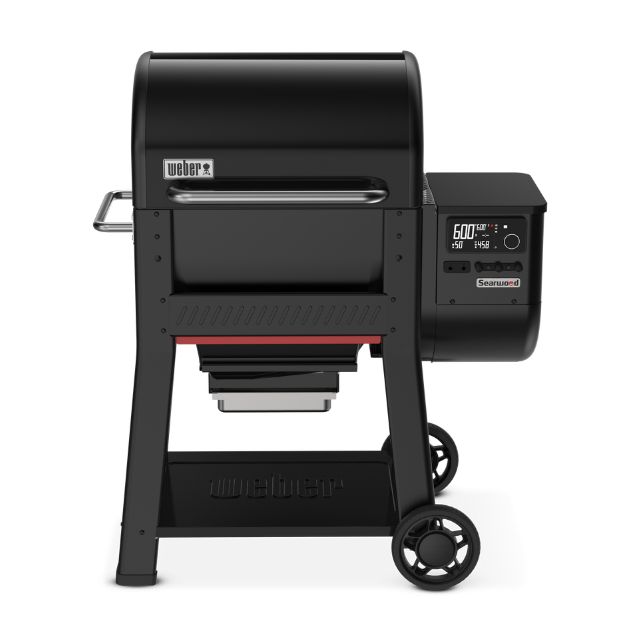
Weber's first real pellet grill entry does what Weber does best: it grills. The Searwood 600 lists around $899 with 648 square inches of cooking space, a 20-pound hopper, and a standout 180–600°F temperature range. The DirectFlame system exposes the full grate to open flame for genuine searing — not the "kinda seared" most pellet grills manage — and the SmokeBoost setting holds 180°F to maximize smoke absorption.
Owners consistently praise the Rapid React PID controller, which the spec sheet claims hits temperature in 15 minutes or less and recovers fast after lid opens. The porcelain-enameled cookbox feels a class above the powder-coated competition. The main gripe is price-adjacent value: at this money, the hopper and cooking area are mid-pack, and you're paying for the Weber badge and sear performance.
Key specs: 648 sq in cooking area · 20-lb hopper · 180–600°F · DirectFlame full-grate sear zone · Rapid React PID · SmokeBoost setting
Pros: - Only grill here that genuinely sears across the full grate - 600°F ceiling is the highest standard max temp on this list - Porcelain-enameled cookbox feels premium and cleans easily - Fast heat-up and strong temperature recovery
Cons: - Mid-pack cooking area and hopper for the price - Weber's pellet grill track record is shorter than competitors' - No pellet sensor
Best for: Grillers who refuse to choose between smoking and searing — if weeknight steaks matter as much as weekend brisket, this is the one.
Check current price: Weber Searwood 600 Pellet Grill
4. recteq Deck Boss 590 — Best Built
recteq built its reputation on overbuilt grills with absurd warranties, and the Deck Boss 590 carries the torch at around $899. The spec sheet shows 592 square inches of cooking area, a cavernous 30-pound hopper, and a 180–700°F range — the widest here. Heavy-gauge steel, stainless steel critical components, and a 6-year warranty round out the package.
Long-term owner reviews are where the Deck Boss shines: owners routinely describe these grills as the last pellet grill they'll need to buy, with minimal part failures over years of heavy use. The 30-pound hopper is the largest on this list and genuinely handles overnight cooks without a refill. The trade-off is cooking area — 592 square inches is the smallest here — and recteq sells direct, so you won't find it at the local big-box store.
Key specs: 592 sq in cooking area · 30-lb hopper · 180–700°F · 304 stainless steel components · WiFi PID controller · 6-year warranty
Pros: - Best build quality and materials on this list - 6-year warranty is double or triple the competition - Largest hopper here — true overnight-cook capacity - Widest temperature range (180–700°F)
Cons: - Smallest cooking area of the five picks - Sold direct — no in-store browsing or instant pickup - Heavier and less feature-flashy than the Camp Chef
Best for: Buy-it-once buyers who value durability and warranty over raw cooking space — the grill equivalent of a cast iron skillet.
Check current price: recteq Deck Boss 590 Wood Pellet Grill
5. Pit Boss 850DX — Best Value
The 850DX is Pit Boss doing what Pit Boss does: maximum grill per dollar. Around $550 buys 840 square inches of cooking space, a 21-pound hopper, a 180–500°F range, and the famous flame broiler lever that opens direct flame for searing up to 1,000°F. WiFi and Bluetooth connect to the Pit Boss app, and the PID controller holds temps in 5-degree increments.
Owner feedback is overwhelmingly positive on value — nothing else touches this much cooking area at this price — with the flame broiler singled out as genuinely useful for finishing steaks. The honest knocks: thinner steel and less insulation than pricier rivals means higher pellet consumption and more temperature swing in cold weather, and the porcelain-coated grates demand more careful maintenance. But at this price, those are acceptable trade-offs.
Key specs: 840 sq in cooking area · 21-lb hopper · 180–500°F (1,000°F direct-flame sear) · WiFi + Bluetooth PID · flame broiler lever · 5-year warranty
Pros: - Unbeatable cooking area per dollar - Flame broiler delivers real open-flame searing to 1,000°F - 5-year warranty beats most competitors - Widely available at major retailers
Cons: - Thinner construction uses more pellets than insulated rivals - App experience lags behind Traeger - Porcelain-coated grates need careful upkeep to avoid rust
Best for: Big families and big appetites on a budget — the most grill you can buy for around $550.
Check current price: Pit Boss 850DX Wood Pellet Grill
Honorable mention: The Z Grills ZPG-10002B (around $600) packs a massive 1,060 square inches and a PID 2.0 controller into a budget package owners rate well for the money — worth a look if the Pit Boss sells out.
Comparison Table
| Grill | Cooking Area | Hopper | Temp Range | Searing | WiFi/App | Approx. Price |
|---|---|---|---|---|---|---|
| Traeger Westwood | 653 sq in | 18 lb | 180–450°F | No | WiFIRE (best-in-class) | ~$700 |
| Camp Chef Woodwind WiFi 24 | 800 sq in | 22 lb | 160–500°F | Yes, 650°F direct flame | Camp Chef Connect | ~$900 |
| Weber Searwood 600 | 648 sq in | 20 lb | 180–600°F | Yes, full-grate DirectFlame | Weber Connect | ~$900 |
| recteq Deck Boss 590 | 592 sq in | 30 lb | 180–700°F | Yes, high-heat | recteq app | ~$900 |
| Pit Boss 850DX | 840 sq in | 21 lb | 180–500°F | Yes, 1,000°F flame broiler | Pit Boss app | ~$550 |
How to Choose: A 60-Second Decision Guide
- You want the Traeger name and the best app, cheapest: Traeger Westwood. Nothing else gets you into the ecosystem for around $700.
- You want every feature and the most cooking space: Camp Chef Woodwind WiFi 24. The spec sheet reads like a grill twice the price.
- Searing matters as much as smoking: Weber Searwood 600. Full-grate direct flame at 600°F is in a different league.
- You buy things once and keep them forever: recteq Deck Boss 590. Six-year warranty, stainless guts, 30-pound hopper.
- Maximum grill for minimum money: Pit Boss 850DX. 840 square inches for around $550 is simply unmatched.
- You regularly cook for 10+ people: Camp Chef Woodwind WiFi 24 or Pit Boss 850DX — both clear 800 square inches.
FAQ
What size pellet grill do I need?
For a family of four cooking weeknight dinners plus the occasional weekend smoke, 550–700 square inches is plenty. If you regularly host or cook multiple briskets, ribs, and sides at once, step up to 800+ square inches. Bigger grills also use more pellets to heat, so don't oversize just because you can.
How many pellets does a pellet grill burn per hour?
Roughly 1 pound per hour at low smoking temperatures (225°F) and up to 2–3 pounds per hour at high heat, depending on insulation, weather, and the grill. A 20-pound bag typically covers 8–12 hours of mixed cooking. Well-insulated grills with double-wall construction consistently use less.
Can a pellet grill actually sear a steak?
Most pellet grills top out around 450–500°F, which gives you a weak sear at best. The exceptions on this list: the Weber Searwood 600 (600°F full-grate DirectFlame), the Camp Chef Woodwind WiFi 24 (650°F Slide and Grill), the Pit Boss 850DX (1,000°F flame broiler), and the recteq Deck Boss 590 (700°F max). If searing matters, buy one of those four — not the Traeger.
Are pellet grills good in cold weather?
They work, but thin-walled grills struggle — temperature swings widen and pellet consumption climbs. Double-wall insulated models (like the recteq and the Traeger Ironwood line above this budget) hold temps far better in winter. In cold climates, an insulated grill or a thermal blanket is worth the money.
Do I really need WiFi on a pellet grill?
No — but you'll use it more than you expect. Remote monitoring means no more hovering by the grill during a six-hour cook, and probe alerts save briskets. That said, a grill with a great controller and no WiFi beats a grill with great WiFi and a sloppy controller every time. Prioritize temperature control first.
Pellet grill vs gas grill — which is better?
Different tools. Gas wins on convenience, instant heat, and searing. Pellet wins on smoke flavor, low-and-slow precision, and versatility — one machine smokes, roasts, bakes, and grills. Many serious backyard cooks end up owning both. If you can only have one and you love barbecue flavor, go pellet.
Verdict
If we had to pick one winner, it's the Check current price: Camp Chef Woodwind WiFi 24 Pellet Grill and Smoker. Nothing else under $1,000 packs this much capability: 800 square inches, a 22-pound hopper, direct-flame searing, adjustable smoke output, four meat probes, and the easiest ash cleanout in the business. It's the most grill for the money that isn't the Pit Boss.
But "best" depends on your priorities. Brand loyalists and app lovers should grab the Check current price: Traeger Westwood Pellet Grill — it's the cheapest ticket into the best-supported ecosystem in pellet grilling. Sear fanatics need the Check current price: Weber Searwood 600 Pellet Grill. Buy-it-for-life types will be happiest with the Check current price: recteq Deck Boss 590 Wood Pellet Grill and its 6-year warranty. And if your budget is tight but your appetite isn't, the Check current price: Pit Boss 850DX Wood Pellet Grill delivers 840 square inches for around $550 — a deal the rest of the industry still hasn't matched.